Stock vs. Semi-Custom vs. Custom Cabinets: Which Wins?
Comparing stock, semi-custom and custom cabinets on price, lifespan, repairs, looks and resale value, so you can pick the right one.
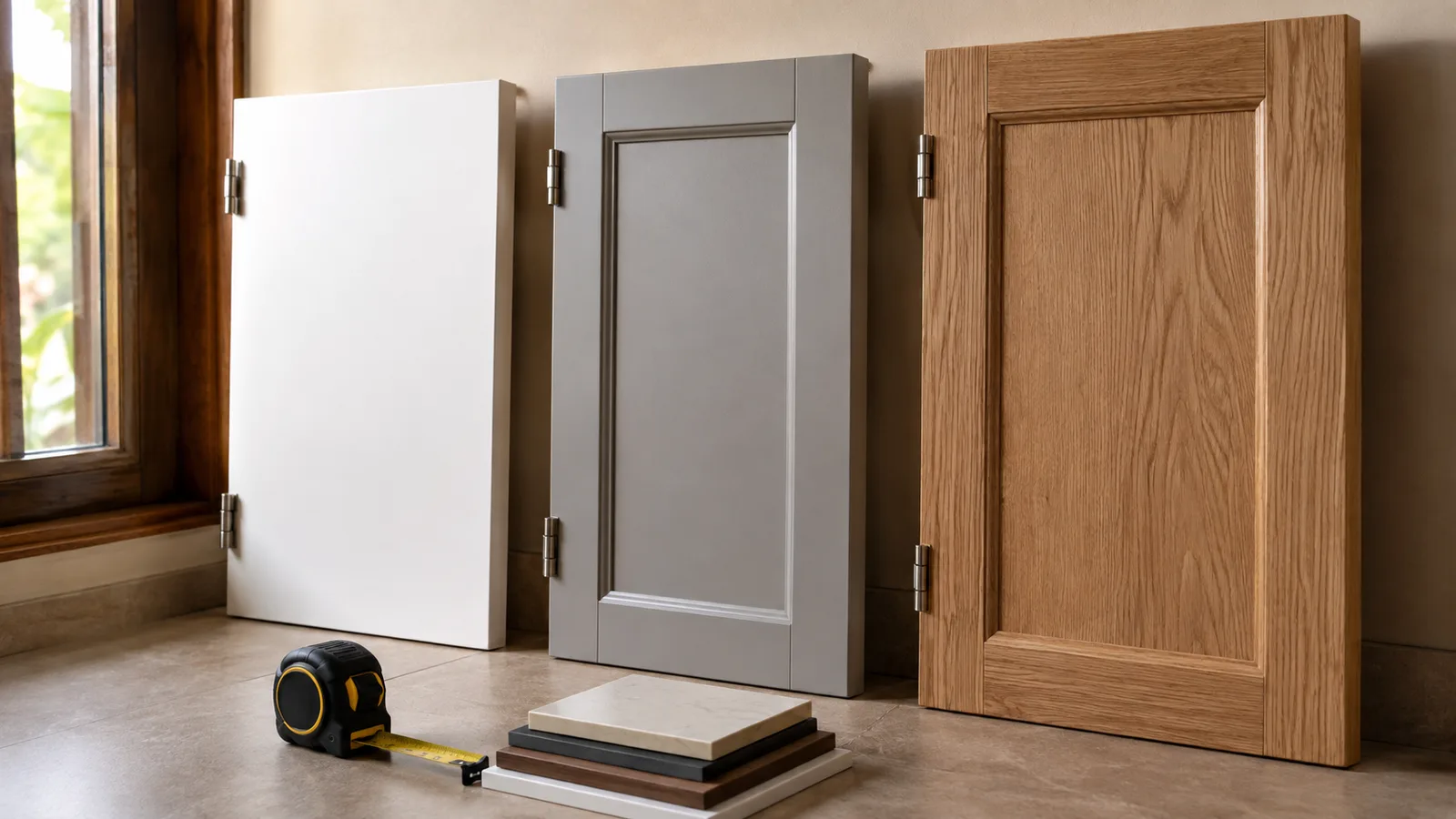
Most people arrive at this decision assuming it is a price ladder: cheap, middle, expensive. It is not. These are three different ways of solving the same problem, and each one wins at something different. There are homes where stock cabinets are the right answer and paying more would be silly, and there are rooms where stock simply will not fit without leaving gaps you will look at every day for fifteen years.
What each option actually is, marketing aside
Stock: modular boxes in fixed sizes, already built and sitting in a warehouse. They come in standardized widths that step up in set increments. You combine them like blocks and cover whatever is left over with filler strips and trim. Installation takes days.
Semi-custom: the same catalog approach, but built after you order, so certain things can change: depth, height, door style, color, some interior accessories. The dimensions still come from a catalog, just with more sizes in between. Lead time runs from several weeks to a couple of months.
Custom: no catalog at all. Your actual wall gets measured, out-of-level spots and plumbing included, and the cabinetry is built for that exact opening. You choose the box material, the panel thickness, the height to the ceiling, the width of each drawer. It is the longest lead time and it requires you to settle decisions before anything gets cut.
Price: where the money goes in each
Stock is cheaper for a concrete reason: the factory produces thousands of identical boxes and nobody comes to measure your house. What often is not in the shelf price is installation, scribing against crooked walls, and filler pieces.
With semi-custom you pay for build-to-order, and that is where options live: every upgrade in finish, hardware, or interior accessory pushes the number. It is easy to configure a semi-custom kitchen right up to custom pricing without gaining the fit that custom would have given you.
With a cabinetmaker you pay for labor and material decisions. The advantage is that you can steer the budget: solid boxes with simpler fronts, or good hardware with a plain finish. That kind of fine-tuning does not exist in the other two, where the factory already decided for you.
Lifespan and repairs: years five through fifteen
A kitchen does not fail at the door. It fails at the hinges, the drawer slides, and the spot where the screw bites into the panel. That is where these three options genuinely separate.
- Stock: thin particleboard boxes in most cases. Screws can work loose with use, and particleboard does not forgive water. Repair usually means replacing the whole unit, and if that model left the catalog, there will be no match.
- Semi-custom: better construction and name-brand hardware across most lines. Replacement parts exist as long as the line is still current, which is not always true ten years out.
- Custom: you can specify the box material and the hardware brand, which is exactly what determines service life. And when something breaks, the part gets repaired: a slide gets swapped, a drawer box gets rebuilt, a front gets sanded and refinished.
Looks and fit to the room
This is where stock shows its limit. If your wall measures 11 feet 2 inches and the boxes add up to 10 feet 10, those four inches get resolved with a filler. One or two go unnoticed; five start to read. Same with height: there is almost always dead space between the upper cabinets and the ceiling that collects dust and grease.
Custom work runs to the ceiling, wraps around the pipe that could not be moved, and uses the awkward corner. In small rooms that difference is not aesthetic — it is storage capacity you did not have before.
Resale value
A buyer cannot tell what brand your hinges are, but they do notice whether the kitchen looks integrated or looks assembled from whatever was available. Cabinets that reach the ceiling, aligned fronts, and no visible fillers read as quality even when nobody can explain why.
That said, do not overspend against the value of your neighborhood. In a mid-range property, a well-executed custom kitchen helps it sell faster; a luxury kitchen rarely returns what it cost. The clearest case for paying for custom is when you plan to stay, or when the space is irregular enough that stock would leave the job half done.
Working out which one fits you
Short version: if your walls are square, budget is the deciding factor, and the room is a standard size, stock does its job well. If you want finish options without redesigning everything, semi-custom is the middle ground. If the space is irregular, you want to use the height to the ceiling, or you plan to live there for years, custom is the one that pays off over time.
Let's look at your space
We measure your real space and show you where the fillers would land with each option.
We've received your project!
We're looking for an available professional for your request. An independent carpenter from our network will reach out to go over the details and put together a quote.
Keep your phone handy so we can get to your request as soon as possible.