Custom Kitchen Cabinet Costs: What Really Drives the Price
What determines the price of custom kitchen cabinets in 2026: linear feet, cabinet material, hardware and finish, explained plainly.
Two kitchens of exactly the same size can come in two or three times apart in price, and neither quote is necessarily wrong. The gap almost never comes from wall length. It comes from the panel material, the hardware, the finish, and how much fitting work the real room demands. Once you understand those variables, you can read a quote and tell whether it is expensive, cheap, or simply a different job from the other one sitting on your table.
Cabinets are priced by linear foot, not “per kitchen”
A serious cabinetmaker does not charge you for “the kitchen.” They measure linear feet: the run of wall the cabinetry occupies, counting base and upper units as one unit of measure. Islands, peninsulas, and oven or pantry towers are quoted separately, because they are independent structures with their own framing.
That is why “small kitchen” means nothing until you know the footage:
- Small: 10 to 13 linear feet, usually a straight run or a simple L.
- Medium: 16 to 23 feet, in an L or U, sometimes with a peninsula.
- Large: 26 feet and up, almost always with an island, tall towers, and more specialty hardware.
Something that surprises a lot of homeowners: small kitchens rarely cost proportionally less. Corners, scribing against out-of-square walls, and finished end panels are fixed work that shows up whether the run is 10 feet or 30.
MDF, plywood, and solid wood: what you pay for in each
After size, the panel material moves the final number more than anything else.
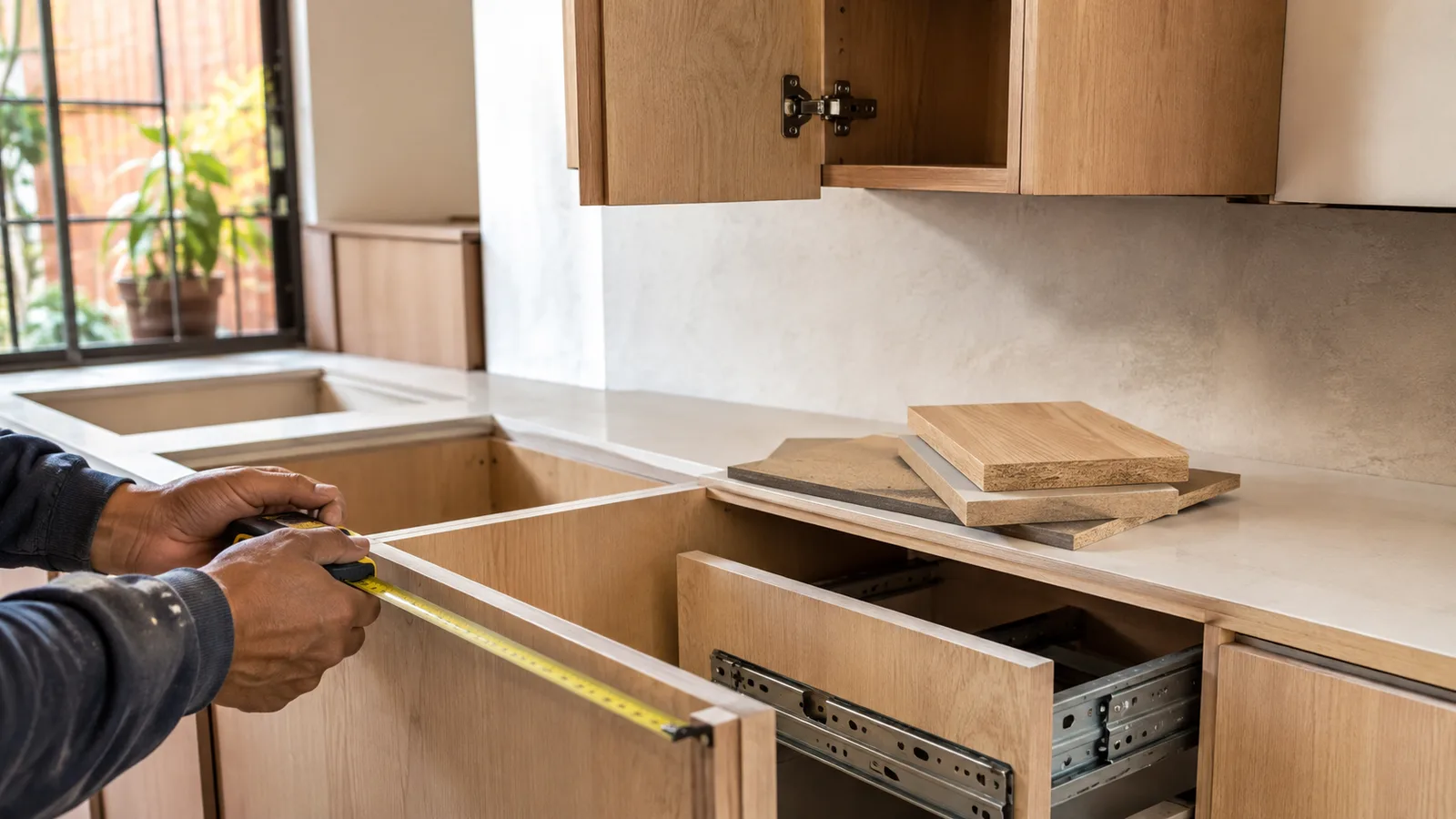
MDF: a perfectly smooth surface, ideal if you want painted doors or routed profiles, because there is no grain to telegraph through the finish. It is the cheapest of the three. Its weakness is water: once it gets wet it swells, and that damage does not come back out. Under the sink it needs reinforcement or a different material for that one cabinet box.
Plywood: it handles humidity far better, stays more dimensionally stable over the years, and holds hinge and slide screws much more firmly, which is exactly where a kitchen starts failing around year five. It costs more than MDF and is usually the most balanced choice for cabinet boxes.
Solid wood: rarely used for an entire kitchen, and anyone offering it that way deserves a follow-up question. The normal approach is solid wood for doors and drawer fronts with plywood boxes, because solid wood moves with changes in temperature and humidity. It is the most expensive option and the one that asks for the most upkeep, but it is also the only one you can sand down and bring back to life twenty years from now.
The most common combination in an honest quote is plywood boxes with painted MDF or solid wood fronts, depending on the look you are after.
Hardware and finish: the invisible percentage
This is where two quotes that look identical stop being identical. Soft-close hinges, full-extension slides with dampers, corner mechanisms, and interior organizers can account for a substantial share of the total without showing up in any photo. They are not decorative extras: they are the parts you operate ten times a day for years.
Finish works the same way. Prefinished melamine arrives from the factory ready to install. A sprayed polyurethane finish requires sanding, a booth, several coats, and drying time, and that is labor somebody pays for. When you compare, check whether the quote names the hardware brand and the finish type, not just “custom cabinets.”
How to compare two quotes without getting it wrong
Before you go with the lower number, confirm that both quotes say the same thing about these points:
- Exact linear footage, and whether the island or towers are included.
- Box material and front material, listed separately.
- Panel thickness and edge banding type.
- Hinge and drawer slide brand and model.
- Whether installation, scribe pieces, toe kicks, and leveling are included.
- Whether countertops, faucets, and appliances are in or out.
Nine times out of ten, a large gap between two quotes is explained by this list, not by the cabinetmaker’s margin.
Get an itemized quote
We measure your actual space and give you a quote broken down by category, not a single number.
We've received your project!
We're looking for an available professional for your request. An independent carpenter from our network will reach out to go over the details and put together a quote.
Keep your phone handy so we can get to your request as soon as possible.